The impact of Search Generative Experience (SGE): The new SEO landscape in 2026
An evolution that redefines the rules of visibility
The digital marketing landscape is undergoing an unprecedented transformation. If 2025 was the year of AI experimentation, 2026 is consolidating as the year of the Search Generative Experience (SGE). Google is no longer just an index linking to third parties; it has become an answer engine that synthesizes information in real time.
This evolution is not a simple algorithm change. It is a structural shift in how users interact with information and, therefore, in how brands must position themselves to remain relevant. At Xarxalia, where data strategy and technology go hand in hand, we analyze what this new paradigm implies for the business fabric and how to transform this “threat” into a competitive advantage.
Visibility is no longer measured only in clicks. It is measured in presence within the response model. And that changes absolutely everything.

What does SGE imply? A strategic look towards the future
The massive implementation of SGE by Google is not an isolated feature. It is the tech giant’s response to a market where immediacy and precision are the new bargaining chips.
To understand the scope of this movement, we must analyze it from three fundamental axes: user experience, semantic technology, and the attention economy.
The end of "Position Zero" as we knew it
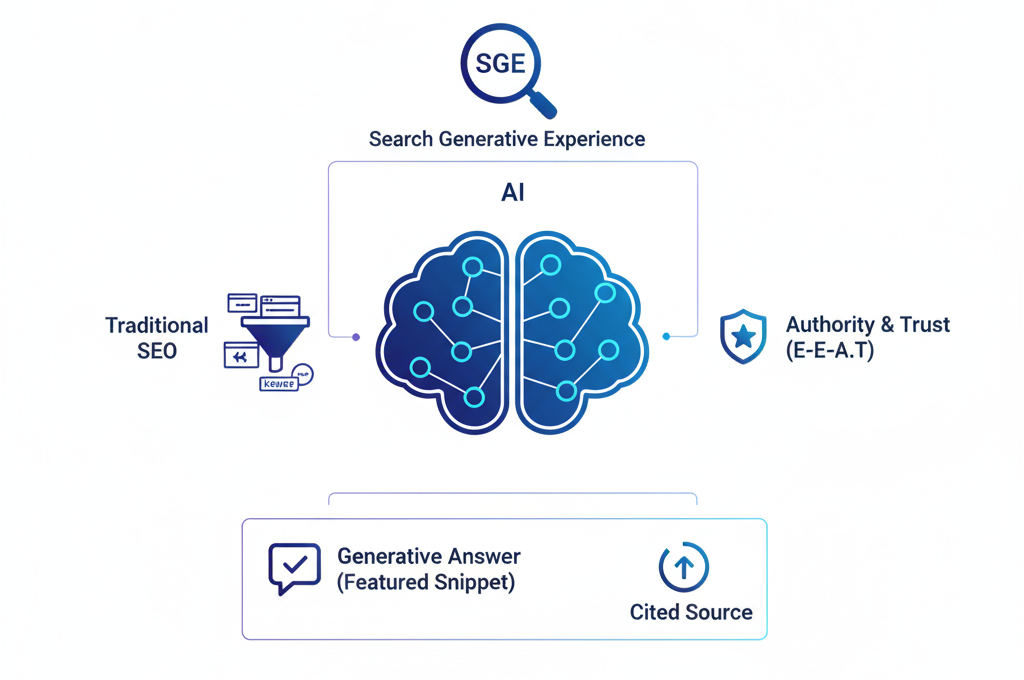
Until now, the main goal was to appear in the featured snippet. Today, these spaces are evolving into more complete summaries and answers that, in many cases, satisfy the user’s query without them needing to leave the search results page.
This forces companies to rethink their KPIs:
- From informational clicks to high-intent clicks: Traffic to blogs with generic answers will drop, but the traffic reaching your website will be of higher quality.
- Cited authority: Success is no longer just "being on top," but being the source that AI uses to build its response.
- Trust ecosystem: Brand signals, external mentions, and online reputation weigh more than ever.
Why your company must bet on "Semantic Authority"
In this new environment, Google has stopped tracking keywords and has started tracking entities and concepts. Content is no longer judged in isolation, but within its overall context.
At Xarxalia, we integrate this vision into our identity and web development projects:
- Content Created for Humans, Optimized for Machines: AI prioritizes texts that demonstrate real experience (E-E-A-T).
- Advanced Structured Data: If AI cannot read your technical structure unambiguously, you do not exist.
- Transmedia Consistency: AI analyzes what you say on your website, on your social media, and in your reviews. Brand consistency is now a technical SEO factor.
What changes in digital marketing from now on
The transition to generative search marks the end of “patch” SEO and the beginning of business-strategy SEO. For years, many companies have treated positioning as something secondary or purely technical. In 2026, if your content doesn’t provide unique value that AI can’t replicate, your organic visibility will disappear.
This movement redefines acquisition dynamics. The result is an environment where content, data, positioning, and digital experience flow naturally. Visibility is expanding toward formats that are already gaining momentum: conversational answers, intelligent assistants, and voice searches integrated into the daily workflow.
In this scenario, classic SEO is transforming into GEO (Generative Engine Optimization). Preparing content to be interpreted, summarized, and reused by language models is no longer optional.
At Xarxalia, we’ve been using competitive intelligence tools for years not as isolated utilities, but as pillars of growth. We analyze search intent, validate niches, and turn data into action. The arrival of SGE doesn’t change our methodology: it makes it more necessary than ever. While others get lost in mass automation, we focus on strategic differentiation.
Risks and points to monitor in the AI era
Every technological evolution brings with it challenges that require active monitoring. Ignoring these points can lead to inefficient investments or loss of market relevance.
Content homogenization: The greatest risk of AI is that all brands end up saying the same thing. Authentic differentiation still depends on the human capacity to decide, interpret, and create unique narratives.
The erosion of human judgment: Delegating the entire strategy to automated tools is dangerous. AI understands data, but it does not understand the emotional context or the cultural nuances of your client in Barcelona, Madrid, or any other local market.
Technical dependency: As search engines become more complex, websites with “technical debt” (slow loading, poor architecture, lack of security) will be penalized more harshly by AI algorithms.

Leading the change through strategy
The Search Generative Experience is not the end of organic traffic; it’s the end of mediocrity in content. The companies that survive and lead this change will be those that understand that technology must serve a clear, human value proposition.
At Xarxalia, we guide our clients through this transition, combining technical rigor with a creative vision that ensures long-term results. We don’t aim for your website to simply appear; we aim for your brand to transcend.
Do you want to know how SGE will affect your specific sector? Don’t leave your visibility to chance. Contact us for a strategic consultancy and prepare your business for the future of search.